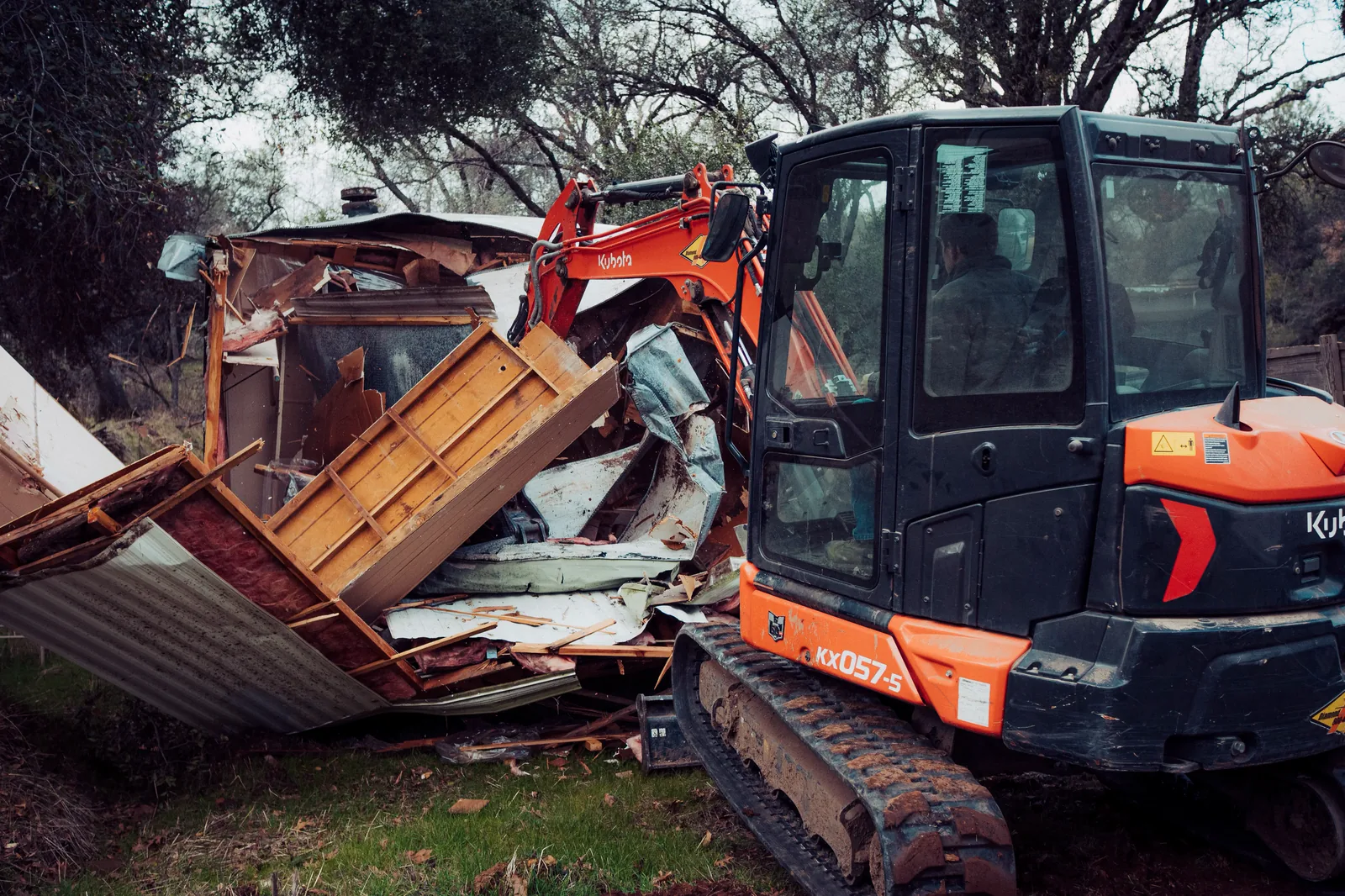
How Much Does It Cost to Demolish a Mobile Home in Florida?
Most single wide mobile homes cost about $3,000 to $8,500 to demolish and haul away. Double wides run about $5,000 to $15,000. Those are the ranges national cost guides publish for a full teardown with disposal included.
Where a job lands in that range depends on a few things. Size, access, what is attached to the home, and what the county wants first. One national guide lists finished Florida mobile home jobs between $1,900 and $6,000. The line items below are what sits behind a mobile home demolition and removal quote in the Tampa Bay area. These are market numbers, not our price list.
What does a single wide cost versus a double wide?
A double wide costs more for a simple reason. There is roughly twice as much home to cut apart, load and haul. Crews also have to separate the two halves before anything moves.
| What is coming down | What national cost guides publish |
|---|---|
| Single wide | $3,000 to $8,500 |
| Double wide | $5,000 to $15,000 |
| By the square foot | $4 to $8 |
The per square foot number is a useful check on a quote. A stick built house is a different job. What a house teardown costs in Florida runs on its own scale.
What is actually in the price?
A demolition quote is not one number. It is a stack of costs, and each one moves with the job.
| Line item | Published range |
|---|---|
| Demolition permit | $100 to $350 |
| Landfill disposal | $40 to $80 per ton |
| Asbestos abatement, only if needed | $2,000 to $5,000 |
| Utility disconnect | often free, up to about $150 |
| Scrap metal credit | $500 to $1,000 off the quote |
Two of these surprise people. Landfill weight is the first. A mobile home gets heavy once the roof, walls, floor and steel frame come down. Asbestos work is the second, and it only applies if testing finds something.
Permit fees are the number to check locally. Your county publishes its own fee schedule, and that is the figure that counts.
Do you need a permit to tear down a mobile home in Florida?
Yes. The Florida Building Code requires a permit to demolish a building or structure. A mobile home counts.
Which office you apply to depends on the address. In unincorporated Hillsborough County, the residential demolition checklist is published by the county. It asks for a recorded Notice of Commencement under Florida Statute 713.13. It also asks for a utility disconnect approval from Hillsborough County Public Utilities. Approval letters or emails from the electric, gas and phone or data providers go in too. Last comes a site plan drawn to scale. It shows the whole parcel with the structure to be demolished marked on it.
Pasco County and Polk County run their own building offices and their own checklists. Confirm the document list and the fee with the county that covers your address. If the lot has a septic system, Hillsborough points septic abandonment to the Department of Health.
What about asbestos in an older mobile home?
Florida’s asbestos program follows the federal demolition rule. The state’s own asbestos FAQ draws a line. A mobile home used as a single family dwelling sits outside that rule. The exception is a home that is part of a larger project.
Two other situations change the answer. A mobile home used for business is covered. So is a park taking down several units at the same time.
When the rule applies, a licensed asbestos consultant inspects the home first. The notice then goes in at least 10 working days before work starts. The state counts working days as Monday through Friday, holidays included.
A county can still ask for a survey on a single home. Confirm with the permit office before you book a date.
What paperwork does a demolished mobile home need in Florida?
This is the step people miss. Florida treats a mobile home like a titled vehicle. The title has to be closed out.
Section 319.30(2)(a) of the Florida Statutes covers it. The owner named on the last certificate of title must surrender that title to the state. That applies once the home is dismantled or destroyed. The state’s own title procedure explains how. The title is marked junked and signed by the owner. It then goes to the tax collector’s office or a license plate agency.
There is a real reason to finish this step. Florida tax rules say a mobile home without a current decal on January 1 is assessed as tangible personal property. The same state procedure gives the tax collector a way to clean that up. They can declare a mobile home title record junked, even without the title in hand. That takes it off the delinquent personal property tax roll.
Salvage rules are a separate question. The state exempts mobile homes worth less than $1,500 retail in undamaged condition. Whether a salvage title or a certificate of destruction applies to your home is a tax collector question. Someone other than the titled owner may file for one. The state can then ask for proof of the county demolition permit. Ask your county tax collector what they want to see, because forms and fees change.
Does the metal get recycled?
Yes, and it can move the price. A mobile home carries a steel chassis, aluminum siding and skirting, copper wire and metal roofing.
National guides put the scrap metal in a single wide at roughly $400 to $1,000. The same guides say contractors will often take $500 to $1,000 off a quote to keep the metal. That is the practical way most owners capture the value. Cutting and hauling a frame yourself takes tools, a trailer and several weekends.
Everything that is not metal leaves as construction and demolition debris. That part is debris hauling priced by the ton.
What pushes a Tampa Bay mobile home teardown up?
Access is the first thing. A home sitting deep in a park takes longer to reach and longer to load. Other units, power lines overhead and a narrow drive all slow a machine down.
Attachments are the second. Carports, screen rooms, Florida rooms, decks, sheds and added roofs are all extra material. Many were built over the years and never came with the home.
Then there is what sits under and around it. Concrete pads, block piers, tie-down anchors, a septic tank and a well all have to be handled. Storm damage adds weight and can make a home unsafe to enter, which slows the work.
Getting a real number for your lot
A published range gets you close. The number for your property depends on what someone sees standing next to the home.
Global Construction and Home Repair looks at the home, the access and the attachments. We check what is left underneath, then price the job. We handle taking the home down and hauling it off and leave a clean pad for whatever comes next. The rest of the property is often grown up around an old home. We can clear the rest of the lot at the same time.
We work about 50 miles around Valrico, which covers Hillsborough, Pasco and Polk counties. Estimates are free. Call or text (813) 239-4231.